
Journaling Unlocks Creativity
Discover Your Inner Artist, One Page at a Time

As a visual artist, I have dedicated countless hours to sketching the world around me. From my youth, when I drew objects and scenes in my home, to capturing people, architecture, monuments, and nature during my travels, each experience has contributed to my understanding of forms and shadows. Whether sketching flowers, trees, or people in public spaces, this practice has taught me how to translate our three-dimensional world into the two-dimensional realms of paper and canvas.
In addition, I have also engaged in something slightly different—journaling. Whereas sketching is a practice that helps visual artists hone their skills, journaling is an activity that anyone can explore.
I have many journals which combine writing and drawing. I like to keep one by my bed because, often as I’m falling asleep, a string of words or an image pops into my mind. I quickly jot down the idea and then expand on it the next day. Sometimes, I find myself writing and writing; other times, pages filled with images spill out. Often, I express an idea by combining both writing and drawing.
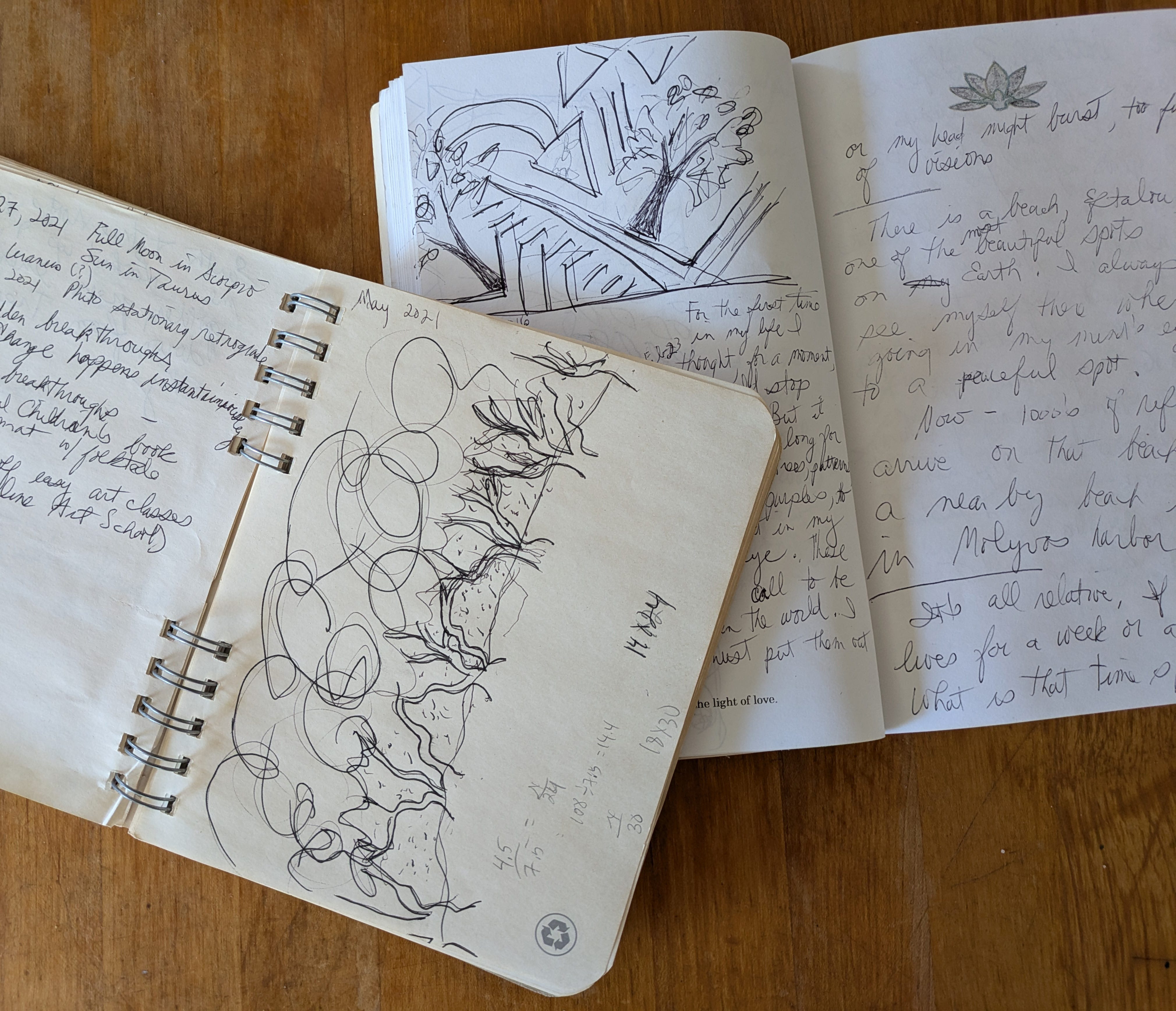
Perhaps the idea of journaling appeals to you, but you hesitate to start. You might even tell yourself that you can’t journal because you’re not an artist. Yet, I firmly believe that creativity is not only about making art—it’s about discovering yourself, embracing your unique voice, and unlocking your limitless potential. Journaling can be the key to unlocking your own creative potential. Whether through writing, visual expression, or a combination of both, journaling offers many benefits.
Benefits of Journaling
Here are some key advantages of both written and visual journaling:
Self-Reflection and Personal Growth: Both forms of journaling provide a space for self-reflection. Writing allows for a deep exploration of thoughts and feelings, while visual journaling can capture emotions and experiences that seem to be beyond words. Journaling promotes self-awareness, encourages exploration of new ideas and perspectives, and helps recognize repetitive patterns in your thoughts and behaviors.
Emotional Release: Journaling serves as a therapeutic outlet for emotions. Writing can help articulate complex feelings, while visual journaling can express emotions that might be difficult to put into words.
Stress Reduction: The act of creating—whether through writing or drawing—can be meditative, helping to clear the mind and reduce feelings of stress, anxiety, and overwhelm.
Creativity Boost: Engaging in both written and visual journaling stimulates creativity. Writing can inspire a longer story or poem, while a quick visual expression might unlock new ideas and perspectives for a more developed art piece. Journaling helps you to uncover your own voice - written and/or visual.
Mindfulness and Presence: Journaling encourages mindfulness, as it requires you to focus on your thoughts and emotions in the present moment, even when reflecting on past events. Additionally, you must be aware of and engage deeply with your physical surroundings. Questions such as: What are you feeling? What are you thinking? What are you seeing? are explored.
Setting Intentions, Goal Setting, and Tracking: Journals can be powerful tools for setting and tracking goals. Assuming an intention to live a more creative life, your journal entries can serve as a personal map for your creative journey. By regularly documenting your thoughts, dreams and progress, you create a tangible record of your evolving creative identity.
Memory Enhancement: Journaling helps improve your memory. Research show that writing by hand engages widespread connectivity across many brain regions. In recent years the research has shown that drawing is an even more effective means of boosting memory. These two tasks—writing by hand—as you would do in your journal—and drawing lock motor and sensory systems together, creating a feedback loop between perception and creation, reinforcing the imagined concept which helps it stick in your memory.
Community and Connection: Sharing your journal, whether written or visual, can foster connection with others. It can lead to discussions about experiences, feelings, and creativity, building a sense of community and support. You might consider starting a small journaling group which meets to share and discuss.
Legacy and Documentation: Journals serve as a personal archive of thoughts, experiences, and creativity. They can be cherished keepsakes that document your journey, allowing you to look back and reflect on your growth over time.
Whether you prefer the written word or visual expression, journaling can be a powerful tool for self-discovery, emotional health, and creative exploration. Combining both methods can enhance the benefits, providing a richer and more fulfilling journaling experience.
How to Get Started
Setting Intentions: Begin by using your journal to articulate your creative intentions. What does living a more creative life mean to you? Write down specific goals, whether they involve exploring new artistic mediums, dedicating time to creative projects, or simply allowing yourself to play and experiment without judgment. This initial step helps clarify your vision and sets a foundation for your creative pursuits.
Walking the Talk: Set a schedule that you can keep. Perhaps journaling is what you do every morning while drinking your morning coffee or tea. Maybe journaling everyday is a larger commitment than you can make—so create a schedule you can keep. If you are drawn to working in your journal outside of that schedule then, please go for it.
Overcoming Obstacles: Is self-doubt or fear of failure causing you to freeze? Remind yourself that your journal is your safe-have. You are not required to share your journal with anyone. It’s a good place to begin exploring your fears by writing and/or drawing them. Success in keeping to your schedule becomes a first small victory over fear.
Cultivating Inspiration
Drawing a blank on what to write or draw? Try creating lists of things that inspire you, whether they are books, art, nature, or experiences. Most likely something on one of your lists will spark you into action
If you’d like some help getting started you can look to prompts created by others. You’ll find many free journal prompts online. I have one available on my Kofi shop—“Four Weeks of Daily Prompts” Download the PDF here.
When is the best time to start? It’s now.